
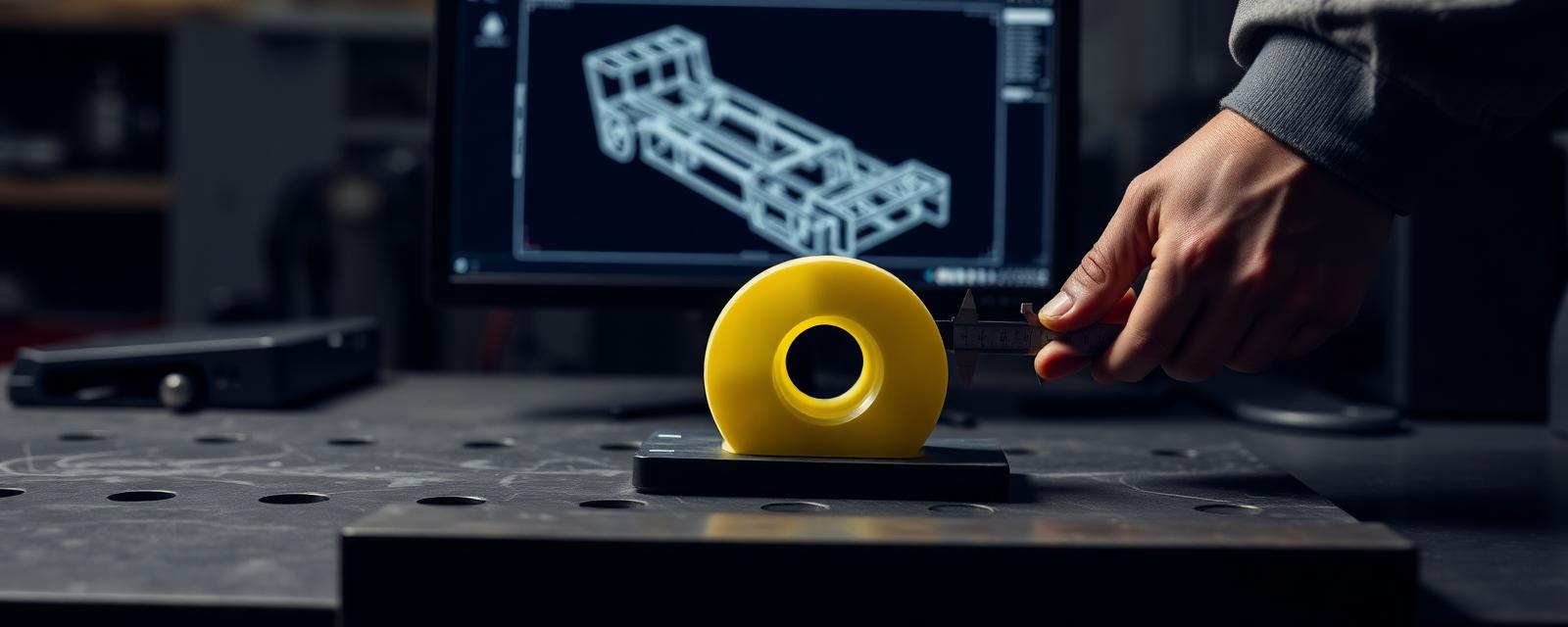
There is no best process, only a best match
Every manufacturing process has a personality: what it renders beautifully, what it tolerates structurally, what it costs at different quantities. Choosing well is most of the job. The part's function, location, detail level and quantity point to the answer - which is why our quotes name the process and the reasoning, not just a price.
MJF nylon: the workhorse for functional plastics
Multi Jet Fusion produces parts in nylon PA12 (and glass-filled variants) that are tough, slightly flexible where thin, and consistent in all directions - properties that suit clips, housings, brackets and anything that must snap, flex or carry load. The surface has a fine matte grain rather than injection-moulding gloss, which suits most under-bonnet and hidden parts perfectly and can be finished further where appearance matters. For functional automotive plastics, MJF is the default we test against.
Resin printing: detail and surface
Stereolithography-family processes cure liquid resin with light, producing smooth surfaces and crisp fine detail - lettering recesses, thin fins, sharp edges. Engineering resins extend the family toward tougher and more heat-tolerant behaviour. The trade-off is that resins are generally more brittle than nylon, so the process suits cosmetic and detailed components - knobs, bezels, grilles - more than parts that live on their snap-fits. It is also the usual route for making the master pattern in vacuum casting.
CNC: metal, precision and load
Machining starts from solid stock - aluminium, stainless steel, brass, or engineering plastics like POM and PEEK - and removes material with tight tolerances. It wins whenever the duty is structural, hot or precise: brackets under real load, threaded components, sealing faces, anything near an exhaust. Cost scales with geometric complexity rather than quantity, so a simple machined part can be economical even as a one-off.
How the choice is actually made
In practice the decision tree is short. Does the part carry load or clip repeatedly? MJF nylon. Is it fine, visible detail? Resin. Is it metal, hot or structural? CNC. Is it a small series where all of them get expensive per unit? Vacuum casting from a printed master. Mixed cases exist - a housing with one high-load feature, a cosmetic part in a warm zone - and there we say plainly which compromise we recommend and why.
FAQ
Can you print in the original material, like ABS?
Reproductions usually use materials better than the original for the duty - nylon or engineering resins - rather than chasing the exact original polymer. The goal is fit, function and longevity.
Which process gives the smoothest surface?
Resin printing, followed by finishing. MJF has a fine matte grain; CNC surfaces depend on the operation and can be excellent.
Is CNC always more expensive?
No. For simple geometries, especially in metal, machining can be the cheapest correct answer even for one piece.
Have a part you can't source?
Request a quoteRelated
Your project stays yours.
Every part we reverse-engineer and produce is confidential and exclusive to the client. We do not resell, share or reproduce a client's parts for anyone else unless the client explicitly authorises it. NDAs available on request.
Part numbers, vehicle names and model designations are manufacturer references used only to identify components. Replique Labs is an independent manufacturer and is not affiliated with, sponsored by or endorsed by any vehicle manufacturer.