
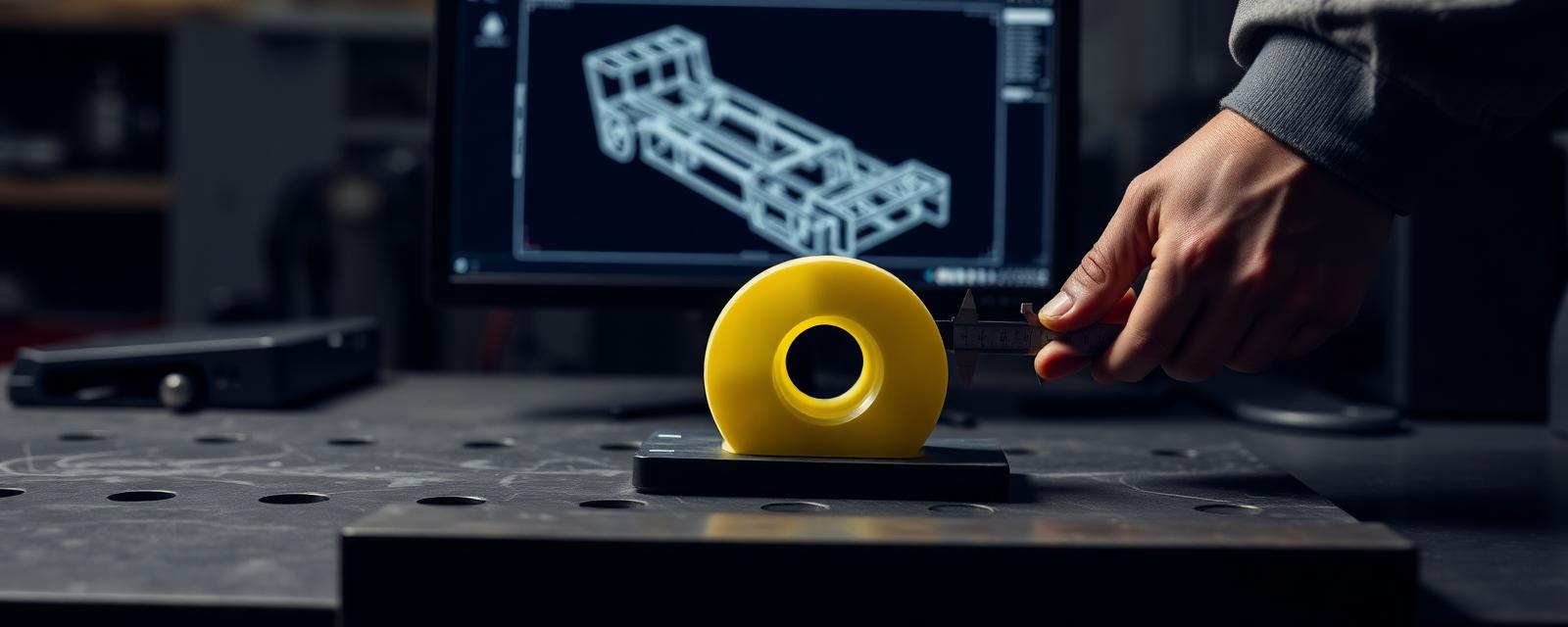
Starting point: no drawings, no CAD, no problem
Almost nothing we remake comes with documentation. The original drawings live in a manufacturer archive, if they exist at all. Reverse engineering means recovering the design from the physical part itself: its geometry, its interfaces, and the intent behind them. A worn or broken sample is a normal starting point - what matters is that the features that define fit still exist somewhere, on the part or on its counterpart in the car.
Step one: capture the geometry
The part is measured systematically: overall dimensions, hole positions, wall thicknesses, and above all the mating features - the surfaces that touch other components. Precise measurement and 3D scanning are used where they help, but capture is only the raw material. A scan of a warped forty-year-old part, copied blindly, reproduces the warp. The skill is knowing which dimensions are design intent and which are decades of distortion.
Step two: rebuild it as a clean CAD model
This is where the value sits. The part is rebuilt as a parametric CAD model - proper cylinders, planes and fillets, not a frozen mesh. Rebuilding forces every dimension to be decided deliberately: the clip is 2.0 mm because it should be, not because the corroded sample happened to measure 1.87. The result is a manufacturable model that can be corrected, adapted and reused for future batches.
Step three: improve what failed
The sample tells you exactly where the design was weak - that is where it broke. A faithful copy would fail the same way. So the rebuild includes an improvement pass: thicker walls where they were marginal, ribs where the part flexed, generous fillets where cracks started, and sometimes a better material than the original ever had. The outside stays true to the original; the engineering underneath gets another few decades of life.
Step four: make it, check it, ship it
With the model finished, the manufacturing route is chosen to suit the part - tough nylon printing for functional plastics, high-detail resin for fine cosmetic pieces, CNC for metal, vacuum casting for small series - and the finished parts are dimensionally checked against the model before shipping. To start the process you need surprisingly little: clear photos from all sides, rough measurements, and the story of where the part lives and how it failed. A quote never requires shipping the original.
FAQ
Do you need the part in hand to quote?
No. Photos and rough dimensions are enough to quote. If the project goes ahead, we may ask for the sample - but only after you have approved the quote.
Is 3D scanning always involved?
It is one tool among several, used where it genuinely helps. Careful measurement and rebuilding in CAD do the real work; scanning alone does not produce a manufacturable part.
Can you copy a part exactly, defects included?
We can, but we usually should not: warp and wear are not design. We reproduce the intended geometry and correct the known failure points unless you ask otherwise.
Have a part you can't source?
Request a quoteRelated
Your project stays yours.
Every part we reverse-engineer and produce is confidential and exclusive to the client. We do not resell, share or reproduce a client's parts for anyone else unless the client explicitly authorises it. NDAs available on request.
Part numbers, vehicle names and model designations are manufacturer references used only to identify components. Replique Labs is an independent manufacturer and is not affiliated with, sponsored by or endorsed by any vehicle manufacturer.